
Casting
- Home

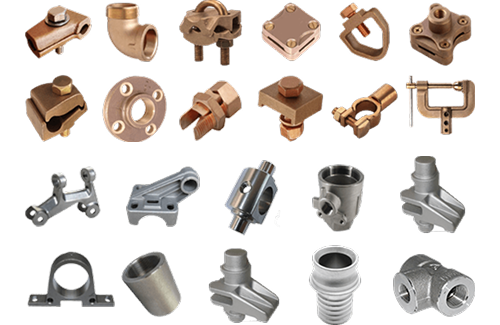

Casting Services
Precision Casting for Complex Parts
Deliver high-quality, custom metal parts with our precision casting services—ideal for producing complex shapes, fine surface finishes, and strong, durable components. Whether you need prototypes or full production runs, our casting capabilities support a wide range of metals and alloys, tailored to your exact specifications.
We specialize in sand casting, investment casting, and die casting, offering versatility for various industries including automotive, machinery, and electrical. Our process ensures dimensional accuracy, material integrity, and cost-efficiency—perfect for both low- and high-volume requirements.
From mold design to final finishing, we provide a complete solution that meets demanding timelines without compromising on quality. Let your designs take shape with strength, precision, and consistency.
Let’s build something powerful together.
Let’s IT Talk
Our Products
Advantage With Us
Types of Casting Processes
At Agastya, we believe building trust builds better business. To cultivate trust, four basic core values guide our behavior in all aspects of our business.
Investment Casting
Also known as lost wax casting, investment casting is an advanced metal forming process often applied in cases where both solid parts and complex, hollow cores are required. We create high-quality metal parts using disposable patterns that are particularly functional and cost-effective.
In the investment casting process, wax is injected into a metal die to make a pattern. This pattern is a replica of the part to be produced. The castings are then coated in ceramic, dewaxed, and heated to a high temperature – which depends on the alloy or metal used for the castings. The hot alloy then flowed into the hot cast shell. Any rest ceramic is blasted from the metal parts and scrapped. Our testing capabilities include a full physical, chemical, and non-destructive.
Sand Casting
A process typically relying on silica-based materials, the sand casting process involves finely ground, circular grains tightly packed together into a smooth molding level. It is a cost-effective process that can be produced in both small and large parts.
In sand casting, a wooden and metal pattern is used in combination with a sand core box to machine-cast parts and components. melted metal alloys are poured into a sand-cast mold to form the component. The sand is removed after the metal has cooled and the metal is then surface treated or blasted in some way to finish the machining process.
Die Casting
Die casting involves the molding of materials under high pressure and consists of a cold chamber, a hot chamber, and multi-slide hot chamber casting. Hot chamber die casting is generally used for the classification of magnesium zinc and other alloys with lower melting points. Cold chamber die casting is used for metals with a higher melting point, such as aluminum.
The three alloys mainly used in die casting are zinc, aluminum, and magnesium. These allow all to possess strong corrosion resistance, hardness, high strength, high thermal and electrical conductivity, and incredible EMI/RFI shielding properties.
There are several benefits to die-casting services, such as that they allow for the creation of complex shapes namely external threads. This can help to minimize secondary operations and can much lower production costs.
Die casting also provides:
- Improved production speed due to fewer steps from material to finished product.
- Reduced scrap metal
- Tight tolerances
- Variable wall thickness
- mprove product life
- Improved surface finish and stability
Permanent Mold Casting
Permanent mold casting is a process used in which permanent or reusable molds consist of mold cavities, machined into a metal die blocks, and appropriate for repetitive use. These molds help to shape the liquid-casting metals into the required part.
Permanent mold casting services help to maintain gross dimensional stability. benefits for machining, however, are smaller due to the finished casting being much closer to the final specification. This process creates castings that are compact, tighter, and stronger, requiring less finishing and surface treatment.
Plaster Casting
Plaster casting is a casting process similar to sand casting. Instead of using sand in the process gypsum, a mixture of water, and strengthening compounds are used.
Casting can be used for a wide variety of industries including
- Medical
- Automotive
- Electronics
- Firearms
- Industrial equipment
- Telecommunications

Stringent Quality Measures
Quality assurance activities are focused on the processes followed to create the deliverable.

Product Customization
We adding customization solution into all the products like product materials, size, logo etc.

Competitive Price
With the market becoming more and more competitive, We should carefully implement an effective competitive pricing

On Time Delivery
We delivered all the products with Tamper proof packaging and On Time Delivery.